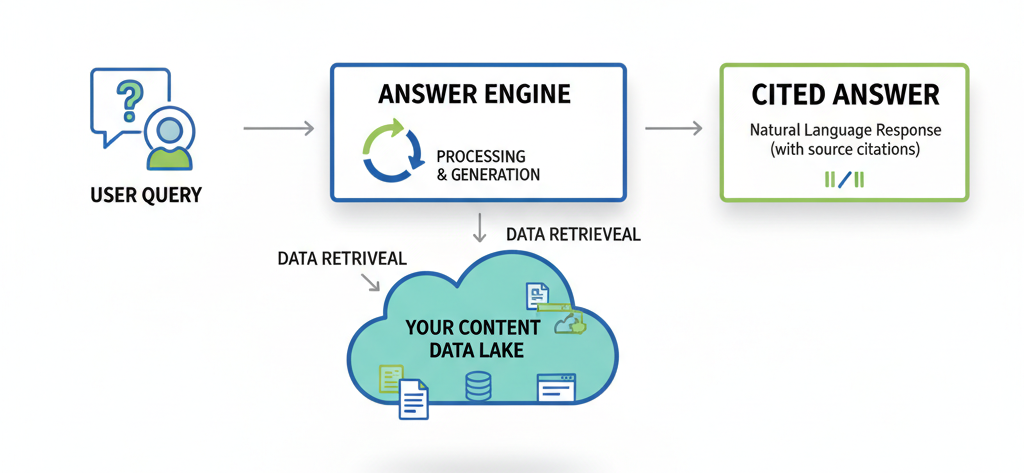
The search world has transformed dramatically over the past two years. AI-driven search—from Google’s AI Overviews to ChatGPT, Perplexity, Gemini, and Claude—has completely changed how people discover information online. For newcomers, this shift feels intimidating. The classic SEO playbook of cramming keywords and chasing backlinks still has value, but it’s no longer sufficient on its own.
This AI SEO for beginners guide covers everything you need: what AI SEO actually means, how it differs from old-school SEO, practical step-by-step strategies, the most useful AI SEO tools, and a ready-to-use checklist to help you gain visibility in both Google and AI search platforms.
Let’s cut through the noise and create a system that delivers real results.
What Is AI SEO?
AI SEO refers to the process of preparing your website and content so that both conventional search engines (Google, Bing) and AI-powered search platforms (ChatGPT, Gemini, Claude, Perplexity, Google AI Overviews) can find, interpret, reference, and suggest your material.
The term is used in two distinct ways, and grasping this difference is essential:
- Leveraging AI as an SEO assistant – Using tools like ChatGPT, Claude, or Gemini to create drafts, group keywords, produce schema, or run technical audits. This speeds up traditional SEO but doesn’t fundamentally alter the game.
- Preparing for AI-powered search – Structuring your content so it’s clear, authoritative, and easily quotable, making AI models view it as a reliable source worth referencing in their responses. This represents the true paradigm shift.
AI SEO means optimizing your site so AI-powered search engines discover, reference, and recommend your content.
AI SEO in 2026 isn’t about quick fixes—it’s about establishing systems that build visibility across both human and machine audiences.
The Reality Behind AI SEO
AI SEO isn’t a magical solution that writes your blog posts and instantly generates massive revenue. It involves using machine learning to manage the repetitive tasks that humans simply can’t do quickly enough: mapping user intent, analyzing content intelligence, and handling technical optimizations.
Many people discussing AI SEO are really talking about using ChatGPT to produce meta descriptions faster. Others mean getting their website featured within an AI-generated response. These are completely different objectives, and only one represents something genuinely new. This guide addresses both, with special attention to the second—the one that determines your visibility in the AI-powered search landscape.
Why AI SEO Matters in 2026
AI Search Is Happening Right Now
By mid-2026, a substantial percentage of search queries generate AI-produced summaries at the very top of the results page. If your business isn’t mentioned in that summary, you’ve lost the opportunity before anyone even clicks through to your site.
The 80% Reality
More than 80% of search queries now produce an AI-generated summary at the top of the screen. Traditional blue links are increasingly becoming secondary. The visibility game has evolved from “ranking first” to “being featured in the AI response.”
Most Pages Get No Traffic
Relying solely on traditional SEO carries significant risk. Approximately 96% of web pages receive zero traffic from Google. AI SEO provides an additional pathway to get discovered.
AI Search Visitors Convert at Higher Rates
Research from Semrush in 2025 revealed that traffic originating from AI search results leads to 4.4 times more purchases compared to standard organic visits. You’re not just chasing views—you’re attracting visitors who are more likely to buy.
Google continues to handle billions of daily searches and delivers roughly 190 times more traffic than ChatGPT, but AI search is expanding quickly. SEO serves as the foundation for both channels.
Benefits of AI SEO
1. Accelerated Content Development
AI tools can generate outlines, draft material, and refine existing pages in minutes instead of days.
2. More Intelligent Keyword Discovery
AI examines search intent, competitor weaknesses, and topic groupings to uncover opportunities that humans often miss.
3. Enhanced Content Refinement
AI-powered content optimization enables teams to work faster while maintaining quality standards.
4. Broader Platform Visibility
AI SEO helps you appear not only in Google search results but also across AI platforms like ChatGPT, Perplexity, and Gemini.
5. Stronger E-E-A-T Signals
AI tools assist in identifying gaps in experience, expertise, authority, and trustworthiness.
6. Improved Conversion Performance
Visitors from AI search convert at 4.4 times the rate of standard organic traffic.
7. Scalable Content Updates
AI workflows make it straightforward to refresh and enhance content at scale.
8. Competitive Edge Through Intelligence
AI analyzes competitors and uncovers gaps you can exploit.
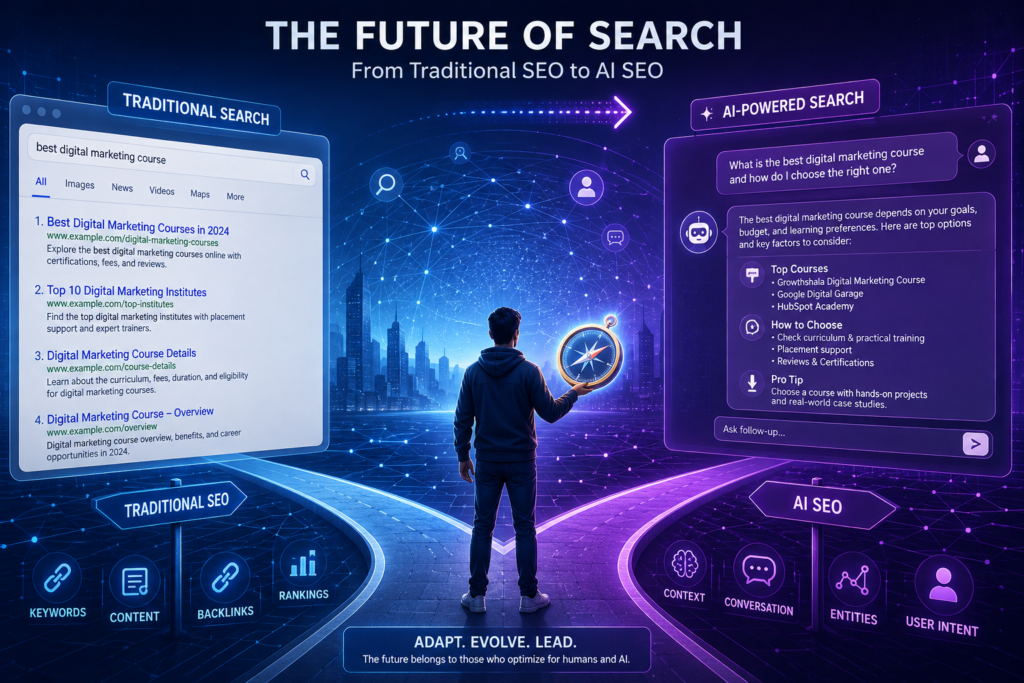
Traditional SEO vs AI SEO
| Aspect | Traditional SEO | AI SEO |
|---|---|---|
| Primary Objective | Achieve #1 ranking in blue links | Get referenced in AI-generated responses |
| Target Platform | Google search results | Google + ChatGPT + Perplexity + Gemini + Claude |
| Optimization Focus | Keywords, backlinks, technical factors | Entities, topical authority, structured data, E-E-A-T |
| Content Approach | Keyword density and page-specific optimization | Topic clusters and entity-based authority building |
| Success Measurement | Rankings and organic traffic volume | AI citations + rankings + referral traffic |
| Core Mindset | “How can I rank for this keyword?” | “How do I become the trusted source AI relies on?” |
| User Experience | Important but secondary | Core Web Vitals + UX are now ranking factors |
| Content Format | Standard blog articles | Extractable Q&A, descriptive headings, standalone answers |
Traditional SEO isn’t obsolete. For many queries without AI answer boxes, a ranked blue link still earns the click. The smart approach in 2026 is a dual strategy: continue ranking for queries where AI features don’t appear, while separately optimizing your content structure for questions where AI engines provide direct answers.
The evolution: Old SEO = Ranking pages. AI SEO = Becoming the source AI tools reference.
How AI Search Engines Work
Modern AI search engines (ChatGPT, Perplexity, Gemini, Claude, Google AI Overviews) don’t simply list links. They respond to questions by synthesizing information from across the web. Here’s how they determine what to reference:
The Fan-Out Query Approach
Contemporary AI search rarely answers a question in one pass. It breaks the query into smaller sub-questions, searches each one individually, reads the top results, and combines pieces into a cohesive response.
The practical takeaway: your content needs to directly answer the smaller questions that an AI extracts from a larger query.
AI Citation Ranking Factors
For Google Gemini:
- Schema Markup – Helps AI comprehend your content
- Google Authority – Backlinks and domain strength
- Topic Coverage – Thorough exploration of the subject
Gemini draws from top search results. Without authority, even perfect topic coverage won’t secure a spot in AI Overviews.
For ChatGPT (and Copilot):
- Entities – Clear definitions and relationships between concepts
- Authority Signals – Backlinks and references
- Reputable Citations – Mentions in trustworthy sources
- Formatted Answers – Q&A sections with direct responses
For Claude:
- Clarity – Clean, straightforward writing
- Neutrality – Objective, balanced presentation
- Explainability – Clear explanations of concepts
- Trusted Citations – Links to authoritative references
What Makes Content Worth Citing
- Extractability – Clear, self-contained answers, definitions, lists, and Q&A segments that a model can readily extract
- Trust Indicators – Genuine experience, named authors, and E-E-A-T expertise
- Entities and Topical Depth – Thorough coverage so engines recognize you as an authority
- Freshness – Outdated pages get passed over for current ones
- Structured Formatting – H2s phrased as questions, 40-60 word answer blocks after each H2
- Specificity – Reference specific people, products, and companies by name
AI SEO Workflow
The AI SEO workflow combines traditional SEO fundamentals with AI-powered optimization. Here’s a modern approach based on industry best practices:
Phase 1: Audit & Discovery
- Connect Google Search Console to identify your best-performing pages
- Use content audit tools to find quick wins (pages with low optimization scores but high ranking potential)
- Filter for pages with recent ranking drops—these represent immediate opportunities
Phase 2: Topic Research
- Use topical mapping to find semantically-related subjects where you already have authority
- Identify content gaps that competitors are covering
- Build topic clusters to strengthen your topical authority
Phase 3: Content Creation & Optimization
- Use AI tools to draft outlines and create content briefs
- Write with genuine expertise and unique insights
- Optimize using AI content editors
- Auto-insert missing entities and facts
- Add internal links
Phase 4: Technical Optimization
- Add structured data (schema markup)
- Publish an
llms.txtfile to guide AI crawlers - Ensure Core Web Vitals are healthy
- Submit URLs to Google’s Indexing API
Phase 5: Monitoring & Refreshing
- Track AI citations using specialized tracking tools
- Monitor AI referral traffic in GA4
- Refresh content regularly using AI workflows
- Update pages with new insights and fresh data
AI SEO in 2026 isn’t about shortcuts. It’s about building systems.
Step-by-Step AI SEO Process
Step 1: Focus on Intent, Not Just Keywords
AI search engines care more about what users actually want than which specific words they type. Concentrate on search intent—informational, commercial, transactional, or navigational. Ensure your content aligns with the correct intent.
Step 2: Build Entity-Based Optimization
Think in terms of topics and entities, not isolated keywords. An entity is a defined object—a person, place, thing, or concept. Google’s Knowledge Graph and OpenAI’s citation algorithms prioritize entities that are consistently verified across platforms.
Write with precision. Define your terms, distinguish between similar concepts, and connect related entities.
Step 3: Develop Comprehensive Pillar Content
Create in-depth content that thoroughly answers user questions. Build topic clusters around pillar pages. Write about related subtopics and interlink them effectively.
Ranking for more fanout queries substantially increases your chances of being cited by AI.
Step 4: Strengthen E-E-A-T Signals
E-E-A-T stands for Experience, Expertise, Authority, and Trust.
- Demonstrate real experience—write from personal knowledge
- Reference specific people, products, and companies by name
- Include original insights, expert quotes, and practical examples
- Add author bios with genuine credentials
- Update content dates to show freshness
Step 5: Structure Content for AI Consumption
- Phrase your H2s as questions that mirror how people naturally ask questions
- Add a 40-60 word answer block immediately after each H2—this is the segment AI answer engines are most likely to quote
- Analysis from early 2026 shows that 44.2% of AI citations come from the first 30% of a text—keep paragraphs concise and place direct answers in the first two sentences
- Keep important content in HTML rather than loading it through JavaScript
Step 6: Implement Structured Data (Schema Markup)
Schema helps AI engines understand and reuse your content. Add:
- Article Schema
- FAQ Schema
- HowTo Schema
- Person/Author Schema (for E-E-A-T)
- Breadcrumb Schema
Don’t apply schema where it doesn’t belong. Adding FAQ markup to a page without an FAQ section does more harm than good.
Step 7: Publish an llms.txt File
An llms.txt file functions like robots.txt but specifically for AI crawlers, giving you control over how models access your content.
Step 8: Build Authority Signals
Authority signals come from citations on other websites—backlinks. Focus on:
- Building domain and page authority through quality backlinks
- Getting mentioned in reputable publications and directories
- Creating linkable assets (original data, tools, comprehensive guides)
Step 9: Optimize Across Multiple Platforms
Extend your efforts beyond Google. Optimize for Bing, Perplexity, and other AI platforms. Ensure your content is accessible across all platforms where AI engines gather information.
Step 10: Monitor and Adapt
SEO in 2026 requires agility. Track what works, adapt quickly, and keep experimenting. Set up:
- Google Search Console for rankings and AI Overview data
- GA4 for AI referral tracking (separate traffic from ChatGPT, Perplexity, Claude, Gemini)
- AI visibility tools to monitor how often you’re cited
Best AI SEO Tools
| Tool | Best For | Free Option |
|---|---|---|
| Surfer SEO | Content optimization, AI visibility tracking | Limited free trial |
| Semrush | Keyword research, competitor analysis, AI toolkit | Free trial |
| ChatGPT | Ideation, drafting, outlines, prompts | Yes |
| Claude AI | Writing, editing, clarity improvement | Yes |
| Gemini AI | Research, topic exploration | Yes |
| RankReady | AI crawler logging for WordPress | Free, GPL-licensed |
| Screaming Frog | Technical SEO audits | Free for up to 500 URLs |
| Google Search Console | Performance monitoring | Yes |
| Google Analytics 4 | AI referral tracking | Yes |
Free AI SEO Tools
- ChatGPT – Content outlines, draft creation, prompt engineering
- Claude – Writing assistance, editing, clarity improvements
- Gemini – Research, topic exploration, information synthesis
- Google Search Console – Performance monitoring
- Google Analytics 4 – Traffic analysis
- Screaming Frog (free tier) – Technical SEO audits
ChatGPT for SEO
ChatGPT is one of the most versatile tools for AI SEO beginners. Here’s how to use it effectively:
ChatGPT SEO Prompts for Beginners
For Keyword Research:
“I run a [your business type] website. Give me 20 long-tail keyword ideas related to [your topic] with high search intent and low competition.”
For Content Outlines:
“Create a detailed blog post outline for ‘How to [do something] for beginners.’ Include H2s, H3s, bullet points, and key topics I should cover.”
For Meta Descriptions:
“Write 5 meta descriptions for a blog post titled [your title]. Keep each under 155 characters and include the primary keyword [keyword].”
For FAQ Generation:
“Generate 15 FAQ questions people ask about [your topic]. Include both common and specific questions.”
For Content Improvement:
“Review this paragraph and make it clearer, more engaging, and easier to read at a 7th-grade level: [your text].”
ChatGPT Best Practices
- Use custom instructions – Tell ChatGPT your role, target audience, and preferred tone
- Provide context – Share relevant information before asking for output
- Edit, don’t copy – Use ChatGPT for drafts and outlines, but add your own expertise
- Verify facts – AI can hallucinate; always check information
Gemini AI for SEO
Google Gemini is deeply integrated with Google’s search ecosystem. Here’s what matters:
Gemini Ranking Factors
- Schema Markup – Helps Gemini understand your content structure
- Google Authority – Backlinks and domain authority
- Topic Coverage – Exhaustive content on the subject
How to Rank in Gemini AI Overviews
The straightforward answer: rank in Google. Gemini draws from top search results. Without authority, even perfect topic coverage won’t secure a spot in AI Overviews.
Gemini SEO Tips
- Focus on backlinks and domain authority
- Use automatic tools to generate schema markup
- Build thorough content that completely exhausts your topic
- Optimize for Core Web Vitals – UX is a ranking signal
Claude AI for SEO
Claude from Anthropic holds approximately 2.2-2.5% search market share and prioritizes different factors than other models:
Claude Ranking Factors
- Clarity – Clean, unambiguous writing
- Neutrality – Objective, balanced information
- Explainability – Clear explanations of concepts
- Trusted Citations – Links to authoritative sources
Claude SEO Tips
- Write with clarity – Define terms, avoid jargon, use simple language
- Be objective – Present balanced information, avoid overly promotional language
- Explain clearly – Break down complex concepts
- Cite sources – Link to reputable, authoritative references
AI Keyword Research
AI-Powered Keyword Research Process
- Use Google Search Console – Find keywords your site already ranks for
- Analyze competitors – See what keywords competitors target
- Use autocomplete – See what people are actually searching for
- Check “People Also Ask” – Find related questions to answer
- Use AI tools – Generate keyword ideas with ChatGPT or Gemini
Keyword Evaluation Framework
The “sweet spot” framework evaluates keywords on four dimensions:
- Demand – How many people search for this?
- Fit – Does this keyword match your business?
- Intent – What does the searcher actually want?
- Difficulty – How hard will it be to rank?
Long-Tail Keywords
Long-tail keywords are specific, often longer search phrases with lower volume but higher intent and less competition. They’re easier for beginners to rank for.
Example: Instead of “SEO tools,” target “best free AI SEO tools for beginners.”
Keyword Clustering
Cluster keywords into topics and intent layers. Create content clusters around pillar pages rather than writing isolated articles for each keyword.
AI Content Optimization
What Is AI Content Optimization?
AI content optimization uses machine learning to analyze top-ranking content and identify exactly what’s missing from yours—down to specific sub-topics and technical data points. It’s about creating content that serves both users and AI engines.
6-Step AI Content Optimization Process
Step 1: Audit Existing Content
Use content audit tools to find pages with low optimization scores and high ranking potential. Filter for recommendations to narrow to pages that need the most help.
Step 2: Identify Gaps
Use AI to compare your content with top-ranking pages. Find missing subtopics, entities, and questions.
Step 3: Optimize Structure
- Phrase H2s as questions that match how people naturally ask things
- Add 40-60 word answer blocks after each H2
- Place direct answers in the first two sentences
Step 4: Add Specifics
- Reference specific people, products, and companies by name
- Include original insights, expert quotes, and worked examples
- Add internal links to supporting pages
Step 5: Technical Optimization
- Add schema markup matched to visible content
- Draft metadata (title tags under 60 chars, meta descriptions 120-155 chars)
- Write descriptive alt text for images
Step 6: Refresh Regularly
Establish a monthly review covering rankings, AI citations, and content decay. Content decay happens when a page’s rankings gradually decline because information becomes outdated.
Tools for AI Content Optimization
- Surfer SEO Content Editor – Auto-insert missing entities and facts
- Surfer Content Audit – Find optimization opportunities
- Surfer Topical Map – Discover related topics to cover
AI SEO Checklist
Phase 1: Foundation
- □ Set up Google Search Console
- □ Set up Google Analytics 4
- □ Install SEO plugin (like Rank Math or Yoast)
- □ Verify site ownership
Phase 2: Keyword Research
- □ Identify primary topics and keywords
- □ Research search intent for each keyword
- □ Build topic clusters
- □ Find content gaps competitors are covering
Phase 3: Content Creation
- □ Create comprehensive pillar content
- □ Phrase H2s as questions
- □ Add 40-60 word answer blocks after each H2
- □ Place direct answers in the first two sentences
- □ Include original insights and expert quotes
- □ Reference specific entities by name
- □ Use bullet points and lists for scannability
Phase 4: Technical SEO
- □ Add Article and FAQ schema
- □ Add Person/Author schema
- □ Publish llms.txt file
- □ Optimize Core Web Vitals
- □ Ensure content is in HTML (not JavaScript)
Phase 5: Authority Building
- □ Build backlinks from reputable sources
- □ Get mentioned in industry publications
- □ Create linkable assets
Phase 6: Monitoring
- □ Track AI citations using AI visibility tools
- □ Monitor AI referral traffic in GA4
- □ Refresh outdated content regularly
- □ Review rankings and adjust strategy
Common AI SEO Mistakes
1. Treating AI SEO as a Quick Fix
AI SEO isn’t about using ChatGPT to generate content and hitting publish. It’s about building systems that create genuine value.
2. Keyword Stuffing
AI search engines are better at understanding context than traditional search engines. Stop optimizing for strings of words and start optimizing for concepts and meaning.
3. Ignoring E-E-A-T
If your content lacks real expertise and authority, AI won’t trust it. Add author bios, demonstrate real experience, and cite sources.
4. Abandoning Traditional SEO
Traditional SEO isn’t dead. Google still delivers roughly 190 times more traffic than ChatGPT. Don’t neglect the fundamentals.
5. Over-Optimizing for AI
Be careful not to let AI flatten your unique brand voice. The elements you contribute yourself—test results, real examples, proprietary data—distinguish your page from everyone else’s.
6. Using Schema Incorrectly
Don’t add FAQ schema to pages without FAQs, or HowTo schema to pages without step-by-step instructions.
7. Neglecting Technical SEO
AI crawlers favor efficiency. Slow loading, poor mobile experience, and subpar Core Web Vitals will hurt your performance.
8. Flying Blind
Many AI SEO guides tell you what to do but not how to measure whether it worked. Without tracking AI citations and referral traffic, you’re operating on guesswork.
AI SEO Best Practices
1. Systems Over Hacks
AI SEO in 2026 isn’t about tricks. It’s about building durable systems that compound visibility over time.
2. Think in Entities, Not Keywords
Build entity-based SEO. Topics matter more than keywords. Define terms, connect concepts, and establish topical authority.
3. Prioritize User Experience
UX and Core Web Vitals are now ranking signals. Fast loading, clean mobile experience, and intuitive navigation all matter.
4. Create Extractable Content
Lead sections with a clear answer, use descriptive headings, and keep definitions and steps self-contained.
5. Strengthen Author Trust
Real author bios, clear sourcing, and updated dates feed the trust judgment.
6. Cover Topics in Depth
Interlink related posts into clusters so engines see genuine subject coverage.
7. Be Transparent with AI
Use AI as a tool, not a replacement. Audit AI-written content for accuracy and trustworthiness.
8. Monitor and Adapt
AI SEO is never “finished.” Keep experimenting, track performance, and adapt to changes.
9. Go Beyond Google
Optimize for Bing, Perplexity, ChatGPT, Gemini, and Claude. Build visibility across all AI platforms.
10. Automate Where Possible
Use AI for technical SEO tasks, content optimization, and performance tracking.
Future of AI SEO
AI SEO Is an Operating System
The shift from keyword optimization to entity authority represents the most significant change in SEO history. Brands that think in terms of entities, intent layers, and adaptability will remain visible. The rest will chase rankings that no longer deliver results.
GEO and AEO Are Emerging
Generative Engine Optimization (GEO) and Answer Engine Optimization (AEO) are becoming essential sub-disciplines. AI SEO serves as the umbrella over both.
The Authority Ceiling
AI doesn’t just evaluate your site—it evaluates where else you exist. Brand signals live off-domain in publishers, platforms, and sources that AI references. On-site optimization establishes eligibility; off-site authority determines citations.
What’s Next?
- Multimodal search – Text + image + video optimization
- AI-assisted link building – Testing new relationship systems
- Predictive analytics – Using AI to predict traffic and rankings
- Personalization – AI-driven personalized content journeys
GEO vs SEO vs AEO
| Discipline | Primary Focus | Goal |
|---|---|---|
| SEO (Search Engine Optimization) | Traditional search results (blue links) | Achieve #1 ranking in Google |
| GEO (Generative Engine Optimization) | Making content quotable for AI models | Get referenced in AI-generated responses |
| AEO (Answer Engine Optimization) | Winning direct-answer positions | Featured snippets, People Also Ask, voice results |
| AI SEO | All of the above | Be discovered, referenced, and recommended by both traditional and AI search |
AI SEO encompasses both GEO and AEO. In practice, you should optimize for all three—they work together.
AI SEO for WordPress
WordPress-Specific AI SEO Checklist
- Write extractable content – Lead sections with a clear answer, use descriptive headings, keep definitions and steps self-contained
- Add the right schema – Article, FAQ, and HowTo markup help engines understand and reuse content. Match schema to what the page actually contains
- Publish an llms.txt file – Functions like robots.txt but for AI crawlers, giving you control over how models access your content
- Strengthen author and trust signals – Add author bios and update dates
- Cover topics in depth – Interlink related posts into clusters so engines see genuine subject coverage
- Keep technical foundation solid – Fast loading, clean mobile, and strong Core Web Vitals still matter because AI crawlers are more sophisticated than ever
Measuring AI SEO on WordPress
Use a measurement layer to track AI crawlers visiting your site. RankReady is a free, GPL-licensed WordPress plugin that maintains a live AI crawler log identifying the bots hitting your site—GPTBot, ClaudeBot, PerplexityBot, Google, and more.
AI SEO for Bloggers
Bloggers’ AI SEO Strategy
- Create in-depth pillar content – Write comprehensive guides that fully answer user questions
- Build topic clusters – Write related posts and interlink them
- Structure for AI citations – Use Q&A headings, answer blocks, and bullet points
- Add schema markup – Article and FAQ schema are essential
- Build authority – Earn backlinks from reputable blogs in your niche
- Refresh content regularly – Update old posts with new insights
- Monitor AI visibility – Track how often AI engines cite your content
ChatGPT for Bloggers
- Use ChatGPT for content outlines and ideation
- Generate meta descriptions and titles
- Create FAQ sections
- Ask for content improvement suggestions
AI SEO for Small Businesses
Small Business AI SEO Strategy
- Focus on local search – Use AI-driven local SEO for hyper-targeted results
- Optimize for voice search – Natural-language searches are growing
- Build technical velocity – Fast hosting and clean design are essential
- Context over keywords – AI cares about solving pain points, not keyword density
- Become the authority – Answer specific questions, solve specific problems
- Use free AI tools – ChatGPT, Gemini, and Google Search Console are free
Small Business Mistakes to Avoid
- Thinking SEO is a “slow burn” you can’t accelerate—AI SEO moves at the speed of light
- Treating every update as a manual task—automate with AI
- Ignoring Core Web Vitals—AI prioritizes fast, clean sites
FAQs
1. What exactly is AI SEO?
AI SEO involves optimizing your website and content so both traditional search engines and AI-powered search platforms (ChatGPT, Gemini, Claude, Perplexity, Google AI Overviews) can discover, interpret, reference, and recommend your material.
2. How does AI SEO differ from traditional SEO?
Traditional SEO focuses on achieving high rankings in Google’s blue links. AI SEO focuses on being referenced as a source in AI-generated responses across multiple platforms while still maintaining traditional search visibility.
3. Is SEO still relevant in 2026?
Absolutely. Google continues to process billions of daily searches and delivers roughly 190 times more traffic than ChatGPT. SEO remains the foundation for both traditional and AI search.
4. How can I appear in AI search results like ChatGPT and Perplexity?
Create comprehensive, well-structured content with clear headings, build topical authority through clusters, earn citations from authoritative sites, and monitor AI visibility using specialized tracking tools.
5. Which free AI SEO tools should I start with?
ChatGPT, Claude, Gemini, Google Search Console, Google Analytics 4, and RankReady (free WordPress plugin).
6. What is search intent and why does it matter?
Search intent is the underlying reason behind a query. Aligning your content with the correct intent is the single most important SEO concept.
7. What are entities in AI SEO?
Entities are defined relationships and distinctions between objects—people, places, and things. Think of them as “nouns” with clear definitions and connections.
8. How do I find the right keywords for my business?
Use techniques like Google Search Console, autocomplete, “People Also Ask” boxes, competitor analysis, and AI tools. Evaluate keywords using the sweet spot framework: demand, fit, intent, and difficulty.
9. What is E-E-A-T and why does it matter?
E-E-A-T stands for Experience, Expertise, Authority, and Trust. AI engines prioritize content with real experience, named authors, and demonstrated expertise.
10. How should I structure content for AI SEO?
Phrase H2s as questions, add 40-60 word answer blocks after each H2, place direct answers in the first two sentences, and use clear headings throughout.
11. What is schema markup and do I need it?
Schema markup is structured data added to web pages to help search engines understand content and enable rich snippets. Yes, it’s essential for AI SEO.
12. How do I measure AI SEO success?
Track AI citations using specialized tools, monitor AI referral traffic in GA4, and use WordPress plugins like RankReady to log AI crawlers.
13. What’s the difference between GEO, SEO, and AEO?
SEO is traditional search optimization. GEO (Generative Engine Optimization) focuses on making content quotable for AI models. AEO (Answer Engine Optimization) targets direct-answer slots like featured snippets. AI SEO encompasses all three.
14. How can I use ChatGPT for SEO?
Use ChatGPT for keyword research, content outlines, meta descriptions, FAQ generation, and content improvement. Always verify facts and add your own expertise.
15. How do I rank in Google Gemini AI Overviews?
Focus on backlinks, domain authority, schema markup, and comprehensive topic coverage. Gemini draws from top search results, so rank in Google first.
16. What are the most common AI SEO mistakes?
Treating AI SEO as a shortcut, keyword stuffing, ignoring E-E-A-T, abandoning traditional SEO, using schema incorrectly, neglecting technical SEO, and failing to measure results.
17. How often should I refresh my content?
Establish a monthly review covering rankings, AI citations, and content decay. Pages with outdated information lose rankings and AI citations.
18. What is an llms.txt file?
An llms.txt file functions like robots.txt but for AI crawlers, giving you control over how models access your content on WordPress.
19. Can I use AI to write my entire blog post?
You can use AI for outlines and drafts, but you should add real expertise, original insights, and unique examples. AI-generated content needs auditing for accuracy and trustworthiness.
20. What’s the 30-day AI SEO action plan?
Week 1: Set up Google Search Console and conduct keyword research. Week 2: Write or optimize your most important money page. Week 3: Publish one supporting piece for your first cluster. Week 4: Monitor performance and adjust your strategy.
Expert Conclusion
AI SEO in 2026 isn’t about exploiting loopholes or chasing shortcuts. It’s about establishing systems that build visibility across both human and machine audiences. The transition from keyword optimization to entity authority is where many brands still lag behind.
Forget keyword gimmicks. Real AI SEO relies on systems, intent-driven content, and measurable outcomes. Consistency compounds results over time.
The core principles of SEO—search intent, quality content, technical optimization, and authority—remain essential. But in the AI era, they must be applied with fresh strategies and tools. The SEO professionals who thrive will be those who treat optimization as an ongoing process, adapt quickly to changes, and build trust with both humans and AI.
Begin small. Take it step by step. Use the AI SEO checklist in this guide, experiment with the tools, and keep learning. AI SEO is never “done”—it’s an evolving practice.
The landscape is changing. The opportunity is enormous. The question is: will you adapt?
This guide was updated for 2026 with the latest AI SEO strategies, tools, and best practices.
You can also check our other blog
Sarvam AI India’s Answer to Sovereign AI? Models, API & Careers 2026